How to Develop Mono Carton Packaging for Your Product: A Step-by-Step Guide
Knowledge / Packaging Specifics
If you are creating a mono carton for the first time, it can feel like everyone else already speaks a language you were never taught: GSM, die-lines, Pantone, ganging, patching. The good news is that the whole journey comes down to a handful of decisions, and once you know the order to make them in, talking to a manufacturer becomes much easier.
In short, you decide what the pack must do, which board to use, how it will be laid out on a sheet, how it is built, how it is printed and finished, how many variants you need, and what quantity, quality and delivery you expect. This guide walks you through each one in the order we recommend. It is a starting point rather than a complete manual, and many of these topics have articles of their own in this Knowledge Center.
Last updated: November 2026
What Is a Mono Carton?
A mono carton, also called a folding carton, is a box made from a single layer of paperboard. It is printed, die-cut and creased, then shipped flat and folded into shape when the product is packed. You will see mono cartons everywhere: food, pharmaceuticals, cosmetics, personal care, electronics accessories and much more.
It helps to know how a mono carton differs from a corrugated box. Corrugated boxes have 3 or 5 layers (3-ply or 5-ply) with a fluted layer in the middle, and are built for shipping and heavy protection. A mono carton is mainly built for presentation, with light-to-moderate protection. Many products use both: a mono carton on the shelf, packed inside a corrugated shipper for transit.
Step 1: What Does Your Product Need the Pack to Do?
Start with your product, before any thought of design. Note down:
- Dimensions: length, width and height, including any tray, insert, leaflet or accessory that goes in with it.
- Weight: a heavier product needs stiffer board and a stronger construction.
- Fragility: a glass bottle needs far more care than a sachet of tea.
- Moisture, grease or odour: food, oils and cosmetics may need a barrier coating or a liner.
- The pack’s main job: protecting the product, surviving transit, looking good on the shelf, or a mix of all three.
This tells you whether a mono carton alone is enough. A fragile glass product often needs a mono carton with an insert, packed inside a corrugated shipper. A light, sturdy product may only need the mono carton.
It also helps to know where the product will be sold: retail shelf, e-commerce, gifting or institutional supply. Each one handles packs very differently.
Step 2: Which Board Should You Choose?
Board is usually the biggest cost and performance decision. Here are the options you will most often hear about in India.
| Board | What it is | Typical use |
|---|---|---|
| Indian kraft board | Brown board made by Indian mills. Lowest cost. | Utility packs, natural or eco look |
| Imported kraft board | Brown board from overseas mills, priced well above Indian kraft | Premium natural or eco look |
| Grey-back duplex | Recycled board, white top, grey back | Cost-sensitive retail packs |
| White-back duplex | Recycled board, white top, white back | Retail packs where the inside is also visible |
| Natural-shade SBS / FBB | Virgin fibre, natural white shade | Food, pharma, premium retail |
| Bleached white SBS / FBB | Virgin fibre, bright white (sometimes bluish-white) | Premium retail, high-end print |
A small note on terms: in Indian trade, SBS (solid bleached sulphate) and FBB (folding box board) are often used interchangeably, although they are technically different boards. When you get a quote, ask exactly which board and which brand is being quoted.
Which mills make these boards?
In most cases you do not need to name a mill. Your converter will choose a suitable one for the grade you have agreed. If you want to be specific, these are the names you will hear most often:
- Indian kraft board: Maruti and Silvertone are well regarded in North India.
- Duplex board: Khanna is considered a premier mill in North India, and Mehali is a good mill in West India. Siddharth, Edicon and Dev Papers are among the other mills.
- SBS / FBB: ITC, Century (now part of ITC), TNPL and Emami are the predominant mills.
Each mill sells its board under several brand names, graded by quality. Two boards from the same mill can therefore differ, so if consistency matters to you, ask for the mill and the brand name, not just the board type.
What is imported board?
Imported board is also used in India at certain times, for example when it is better value or when a particular grade is in short supply. April Fine, an imported SBS, and Niviea board from China are two examples. Imported board is not automatically better or worse than Indian board. As with any board, judge it by the grade and brand.
What is stocklot board, and should you allow it?
Stocklot board is board that a mill sells at a much lower price, usually because it has very small defects. Converters often buy it to keep costs down. Offcuts, the leftover portions cut from larger sheets or reels, are sold in a similar way.
In most cases, stocklot board does not affect the quality of your printing. If you are very particular about your board, you can simply tell your converter not to use any stocklot board for your job. Expect this to be reflected in the price.
Indicative board prices, November 2026 (per kg)
- Indian kraft board (brown): about ₹40
- Grey-back duplex: about ₹50
- White-back duplex: about ₹54
- Imported kraft board (brown): about ₹70
- SBS / FBB: about ₹75 to ₹85
Please treat these as indicative. Prices move up and down, but the gaps between boards give you a feel for how much each choice changes the cost. From cheapest to costliest: Indian kraft, grey-back duplex, white-back duplex, imported kraft, natural SBS, white SBS.
Matching board to product
- For food and pharma packs, virgin board (SBS/FBB) is the usual choice because of hygiene and low odour. Recycled board is usually not used where it touches the product directly.
- Heavier products need a higher GSM (board weight per square metre) or a stiffer board.
- Fine graphics print best on a smooth, bright surface, which is where SBS shines.
A higher GSM means a thicker, stiffer board, and a higher cost per carton. Your manufacturer can suggest the right GSM based on your product weight and carton size.
Step 3: Will Your Carton Fit a Standard Sheet Size?
This is one of the most overlooked ways to save money and avoid headaches, so it deserves its own step.
Board mills supply paper in standard sheet and reel sizes. Your carton is printed with several copies laid out together on one big sheet (this is called the “layout” or “imposition”), then cut apart. If your carton size fits neatly into a common sheet size, very little board is wasted, and the manufacturer can buy ready stock.
If your carton is a little too big or an awkward size, the layout may leave a lot of unused board, or force the manufacturer to order a non-standard size from the mill. That can raise your cost, and cause delays and uncertainty every time you reorder.
What to do:
- Ask your manufacturer which sheet sizes they stock and run on their machines. Common sizes in the Indian market include 25 × 36 inches and 31.5 × 41.5 inches, though availability varies by board and mill.
- Share your carton dimensions early, and ask if a small change (even 2 to 3 mm) would let more cartons fit on the sheet.
- If your product allows some flexibility, shape your carton around the sheet, not the other way around.
Planned this way, your reorders will not be affected by sheet availability, and your manufacturer will not need to arrange a custom paper size each time.
Step 4: What Construction (Style) Should the Carton Have?
Construction is how your carton is built: how it folds, locks and opens. The most common mono carton styles are:
- Reverse tuck-in (RTI) and straight tuck-in (STI): the simplest cartons, with tuck-in flaps at the top and bottom. Economical and widely used.
- Interlock (1-2-3 snap-lock bottom) cartons: the bottom flaps fold in three steps and lock together, so the base holds without glue.
- Lock-bottom (auto crash-lock) cartons: the base is glued at the factory and locks itself when the carton is opened. These are popular for automatic filling lines and heavier products.
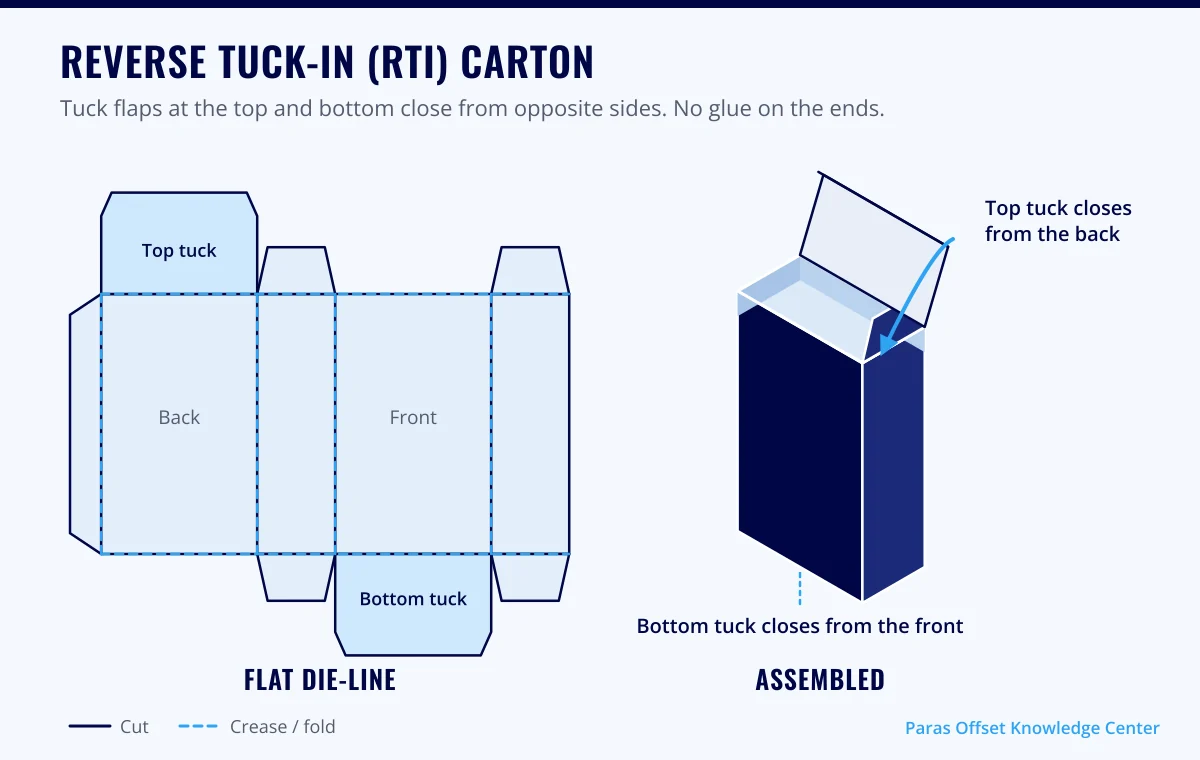
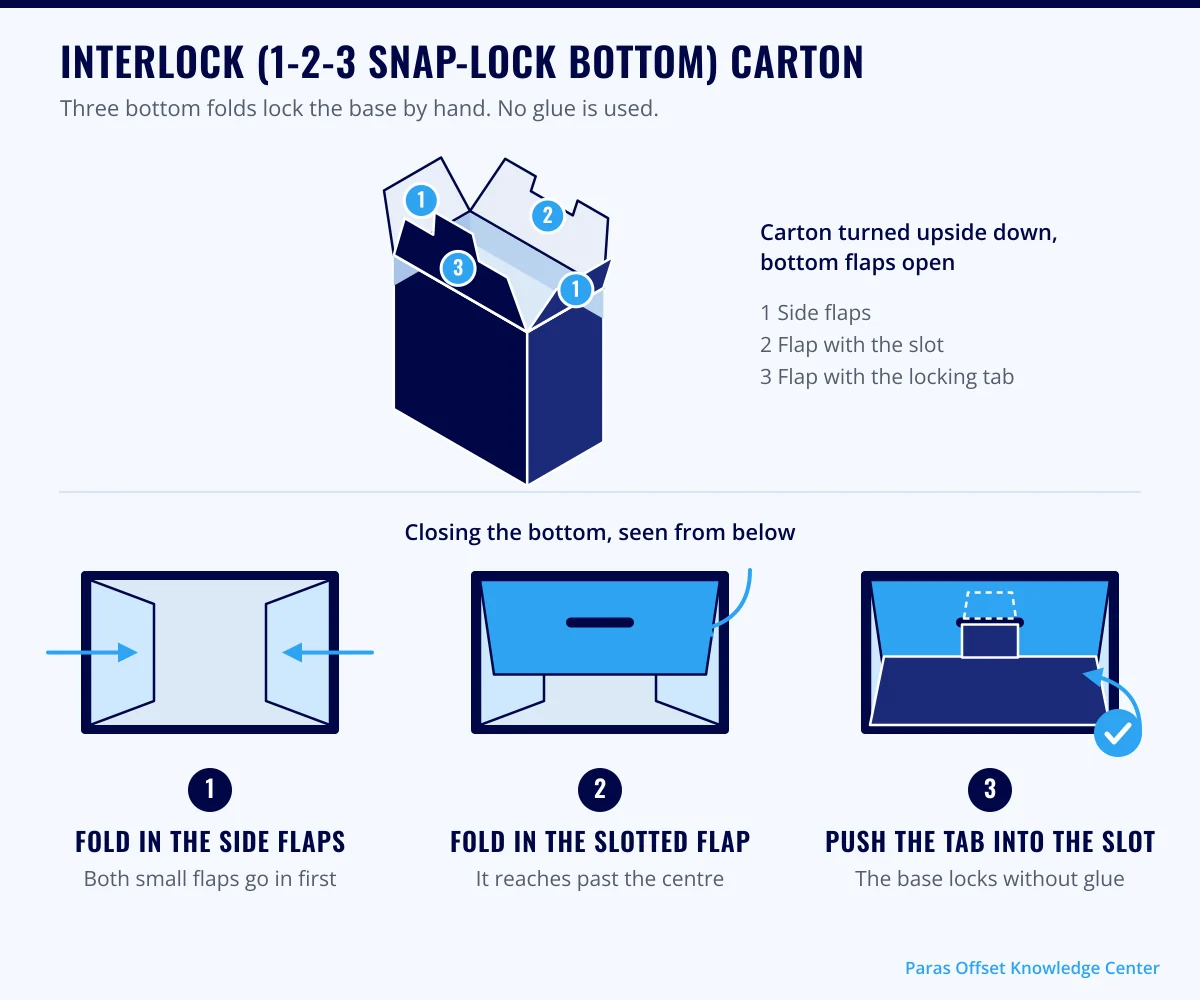
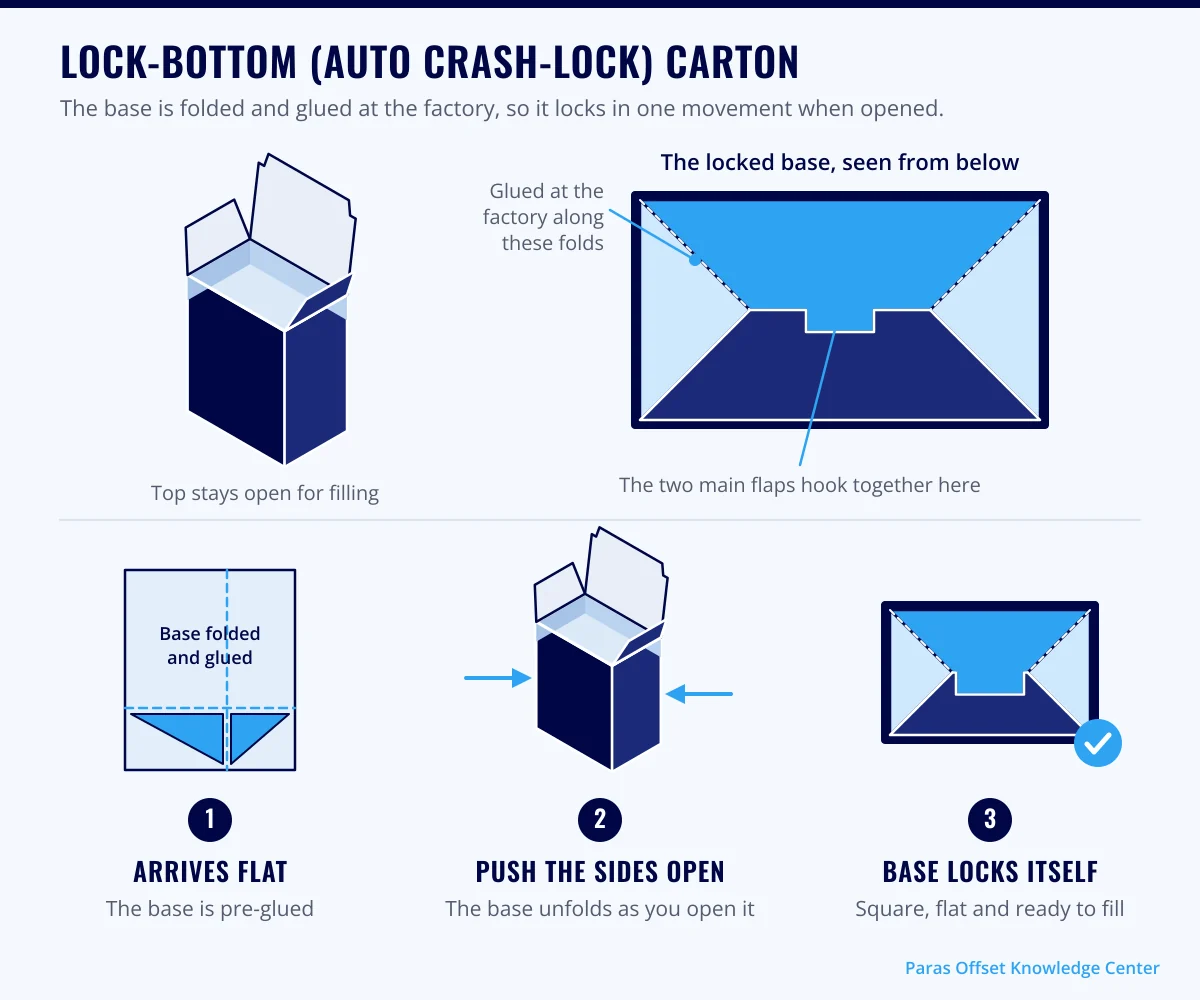
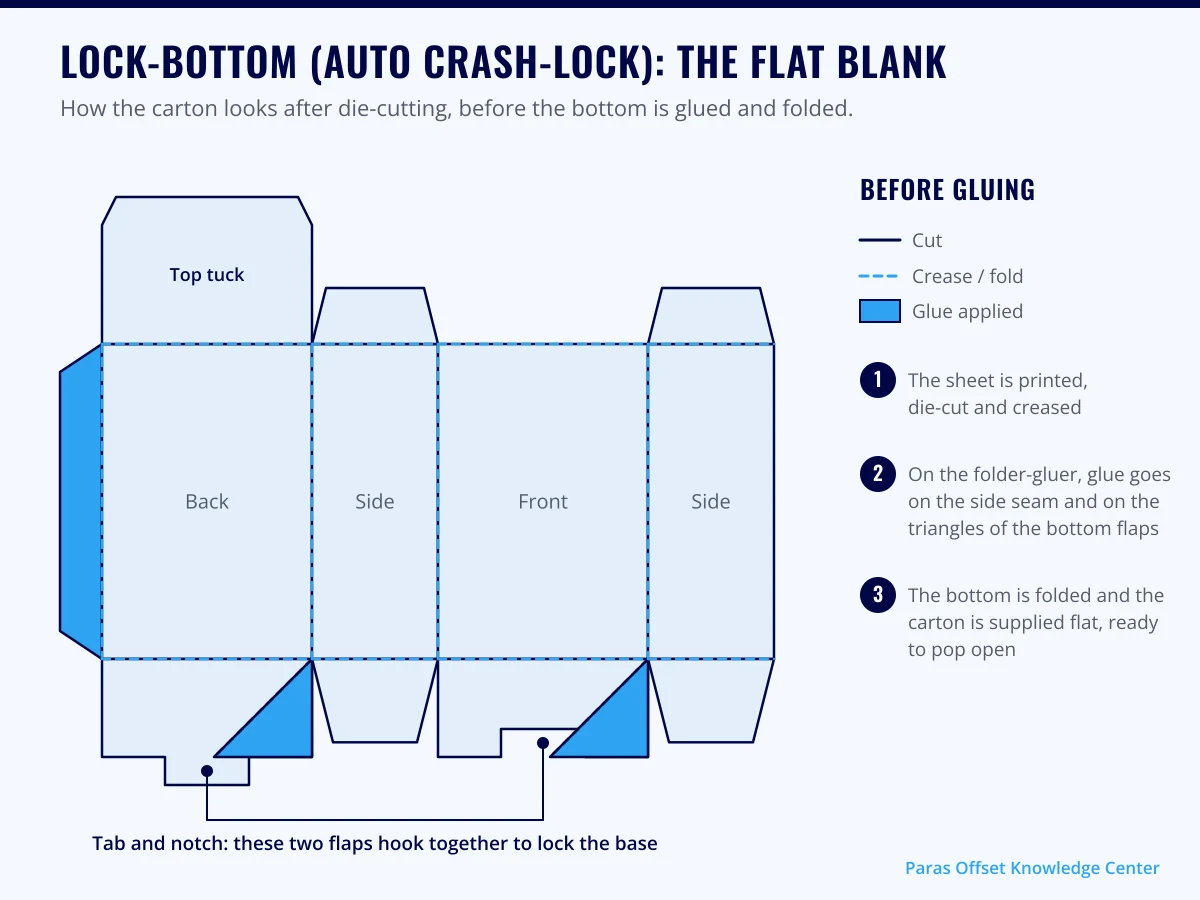
Within each style, there are hundreds of variations: hang tabs, tear strips, dividers, trays, sleeves and windows. To narrow it down:
- Look at competing and similar products on the shelf, and note the styles you like.
- Think about how you will fill the pack: by hand or on a machine. Machine filling needs consistent, machine-friendly constructions.
- Ask your manufacturer for a plain white sample before you commit (see Step 8).
Your manufacturer’s structural designer can then create a die-line, the flat template of your carton, for your product size. Get it signed off before artwork begins.
Do you want a window on your carton?
If your product looks good and customers should see it (a bakery item, a toy, a cosmetic, a gadget), you can add a window. There are two ways to do it:
- Open window: a hole is simply die-cut in the carton. No extra material is needed, and it is plastic-free, but the product is exposed to dust and handling.
- Window patching: the hole is die-cut, then covered from inside with a thin transparent film that is glued in place. This protects the product while keeping it visible.
Window patching is done on a special machine that applies film cut from a reel over adhesive around the opening. A few things worth knowing:
- Film choice matters. PET film is the most common choice, and is generally used for food and cosmetics because it is clear and food-contact approved in many grades. PVC is tougher but is usually kept for non-food products. Other films, such as polypropylene (PP), PLA (biodegradable) or cellulose, are used for specific needs. Ask for food-contact grade film for any packed food.
- Glue areas must stay clean. The area where the film is glued should be free of ink, varnish or lamination, otherwise the patch will not stick well. Your manufacturer will mark this on the die-line.
- Keep text away from the window edge. Leave a safe gap (about 3 mm is a common guideline) between important text or logos and the window edge.
- Expect some extra cost. Windows add a die-cutting feature, film, and a separate machine pass.
Tell your manufacturer early that you want a window. It affects the die, the layout, the finish and the cost.
Step 5: How Should Your Carton Be Printed, and What Are Pantone and Spot Colours?
Printing options include:
- Unprinted (plain) cartons: the lowest cost, with branding added by a label or sticker.
- Single-colour printing: one ink, often for simple or utility packs.
- Multi-colour printing: full-colour (CMYK) with optional special colours.
- Metallised cartons: board with a metallic surface for a reflective look.
What is CMYK?
CMYK stands for cyan, magenta, yellow and black. These four inks are printed as tiny dots in different amounts to create almost any image or colour, which makes CMYK ideal for photographs and complex artwork.
What is a Pantone colour?
Pantone is a company that created a standard colour-matching system, known as PMS (Pantone Matching System). Each shade has a number, such as “Pantone 186 C”. A Pantone shade is a pre-mixed ink made from a fixed recipe, so a printer anywhere can print the same shade and match it again months later.
You will often see letters after the number. “C” means the colour is meant for coated board (smooth surface), while “U” means uncoated board (such as kraft). The same number looks slightly different on each, so tell your manufacturer which board you are printing on.
Is a Pantone the same as a spot colour?
Not exactly, but people use the two words as if they were. Here is the difference:
- A spot colour is a printing method. One ready-mixed ink is printed as a solid colour, instead of being built from CMYK dots.
- Pantone is a brand name and the most popular system for choosing spot colours.
Because Pantone is by far the most widely used spot colour system, “Pantone” and “spot colour” have become interchangeable in everyday talk. Strictly speaking, spot colours can also be custom-mixed to a brand’s own recipe, and a Pantone shade can also be approximated using CMYK, which is cheaper but less exact. Some Pantone shades, such as bright neons, metallics and certain pastels, cannot be matched well in CMYK at all.
When do you need a Pantone?
You do not always need one. A simple rule of thumb:
- Use CMYK for photographs, detailed illustrations and designs with many colours.
- Use Pantone (spot) where one colour must look the same every time, such as a logo, a brand colour, or a large solid area.
- Combine both for most branded cartons: CMYK for imagery, and a Pantone for the brand colour.
Every spot colour needs its own ink and its own printing plate, so every extra Pantone adds cost. This brings us to an important planning point.
Planning colours across several products
Suppose you plan six products, and each designer picks a different Pantone. That means six extra inks to mix, six extra plates, and press washes between jobs. It also makes it hard to print products together later (see Step 7).
Before artwork begins, ask yourself:
- Can all the products share one brand Pantone, and use CMYK for everything else?
- Can variants be told apart by something other than a new spot colour, such as the product name panel or a CMYK-printed band?
- Is a spot colour needed at all, or will a CMYK match be close enough for your brand?
A little thought here saves cost on every run.
Step 6: What Finishing Should You Add?
Finishing gives your carton both protection and appearance. Without it, the ink can scuff in transit and the carton can mark during handling. Your options are:
- No finish: the printed board is left as it is. It offers no protection and no visual effect, and is rarely recommended for retail cartons.
- Water-based (aqueous) coating: environmentally friendly and low cost, with some scuff resistance. It protects less than the other options.
- Hybrid coating: a coating that combines properties of water-based and UV coatings, giving better gloss and scuff resistance than a plain water-based coat.
- UV coating: a hard, glossy (or matte) layer cured under UV light. It gives strong scuff resistance and high shine, and can be applied over the whole carton or only on selected areas (spot UV).
- Lamination: a thin plastic film (gloss, matte or soft-touch) bonded to the printed surface. It gives the strongest protection against scuffing and moisture, but costs more.
Special effects add tactile or visual impact: leafing (foil stamping), embossing, spot UV, SCODIX (raised digital effects), MGI (digital foiling and spot effects) and similar processes. They help your carton stand out on the shelf, and the effect you pick should work with the finish underneath it.
Check compatibility. Not every print process and finish works well together. Something can look great on screen and even be technically possible, yet fail in practice. Ask your manufacturer to confirm that your board, ink, coating and effects all work together, and approve a sample before the full run.
Do you need batch coding?
Most packaged goods need a batch number, manufacturing date, expiry date or MRP on the carton. Decide this now, because it affects both the design and the finish:
- Tell the manufacturer whether the code will be printed on the carton at the factory or applied later on your own packing line.
- Leave a dedicated space for the code in the artwork.
- Check that the finish at that spot accepts the coding method. Glossy coatings and laminations can stop inkjet codes from drying properly, so that area is often left uncoated or treated differently.
- Where regulations apply (food, pharma, cosmetics), confirm the mandatory printed information with the relevant authority or your compliance team.
Step 7: Do You Plan Several Variants of the Same Carton?
If you are planning more than one version of your carton (different flavours, shades, sizes or languages), please tell your manufacturer upfront. It can make a big difference to cost.
Reusing the same die and tooling
If all variants share the same dimensions and construction, they can often share a single cutting die. Only the printing plates change. That saves you tooling cost, compared with making a new die for each product.
What is ganging?
Ganging (also called a gang run or combination run) means printing several different designs together on the same sheet. Instead of printing three variants one after the other, the manufacturer places all three on one sheet, runs the press once, and cuts them apart afterwards.
Why it helps:
- The setup cost (plates, press preparation, wastage at start-up) is shared across the variants.
- Board is used more efficiently.
- You may even be able to order smaller quantities per variant.
What makes ganging work:
- The variants use the same board, same carton size and same finish, and are produced in the same run.
- The colours are compatible. If every variant has a different Pantone, there may not be enough ink units on the press to print them together (see Step 5).
- The quantity ratio is known.
Tell your manufacturer the quantity ratio
Say you want a white variant and a black variant. Will you need them in equal numbers, or is one more popular? Is the ratio 1:1, 3:5, or 2:2:4 across three variants? The ratio helps the manufacturer decide how many copies of each design to place on the sheet. That keeps over-printing to a minimum, and prevents you from ending up with thousands of an unwanted variant.
There is a trade-off. Ganged jobs share a production schedule, so changes to one variant can affect the others. Mention which variants might change later.
Step 8: Why Must You Approve a White Sample (Dummy) and Test It?
Getting a plain white sample or dummy approved before production is critical. A white sample is the carton cut, creased and folded from the right board but without print. It lets you check what a drawing cannot show:
- Does the product fit comfortably, and can it be inserted and removed easily?
- Does the carton close and lock properly?
- Does the board feel stiff enough for the product’s weight?
- Does the construction work on your filling process?
Approve the dummy in writing before artwork, plates and dies go ahead. Changing a size after tooling is made costs time and money.
Planning for secondary packaging
If your cartons (primary packaging) will go into a larger shipping container (secondary packaging), order dummies in the quantity that will go into that container, for example 12 or 24 pieces. That tells you:
- the right size for the secondary container, before you order it
- whether that many cartons fit, stack and hold their shape together
- whether the whole assembly survives transit
Test it the way it will really travel
- Drop test: pack the product in the carton, then in the secondary container, and drop it from a realistic height. Open it and check both the product and the carton.
- Courier test: if the goods will move by courier, ship a packed sample from one city to another, and open it at the destination. A carton that looks strong in your office can still fail on a courier journey, where it faces compression, vibration and rough handling.
Make any changes now while they are cheap, not after 50,000 cartons are printed.
Step 9: How Is Mono Carton Cost Calculated?
Carton cost depends mainly on:
- Quantity: larger runs reduce the unit cost.
- Board type and GSM: the largest single material cost.
- Sheet layout: how many cartons fit on one sheet, and how much board is wasted.
- Printing: number of colours, and any Pantone or special inks.
- Finishing and effects: every added process adds cost.
- Extras: windows, inserts, batch coding and special packing.
One-time costs and repeat costs
Keep these two separate when comparing quotes:
- One-time (tooling) costs: printing plates, cutting die, embossing blocks, foil blocks and any special tooling. These are incurred when the carton is first made, and usually not again on repeat orders.
- Repeat costs: board, ink, coating, labour and machine time, paid on every run.
A carton with a low unit price but high tooling cost can still be cheaper over its life than one with the opposite pattern. Always ask for both figures.
Who looks after the dies, plates and blocks?
A common question from first-time buyers is how tooling is paid for, and what happens to it after the first order. There is no single rule, so this is worth settling when you place your first order. Ask your printer:
- Is tooling charged separately or built into the carton price? Some printers show dies, plates and blocks as a separate line item on the first order. Others spread the tooling cost across the unit price, so you never pay for it out of pocket. Neither is wrong, but you need to know which one you are comparing when you look at quotes side by side.
- Who owns the tooling? Depending on the arrangement, it may belong to you or to the printer. This matters if you ever want to move the job to another printer.
- Who stores and maintains it, and who pays if a die, plate or block wears out and needs replacing over long or repeated runs?
Getting these answers in writing at the start avoids surprises on your second or tenth order.
Why your total expected quantity matters
Please tell your manufacturer both the quantity you need now and what you expect over the coming year. Suppose you order 5,000 pieces today but expect lakhs later. A good converter will plan the layout, tooling and machine size for the larger volume, even if the first run looks relatively expensive. In the long run, unit costs fall sharply as volume grows.
The opposite also happens. A quote built only for 5,000 pieces can look attractive, but the setup may not scale, so the price barely drops as you grow. Share your forecast, expected reruns and growth plan early.
Step 10: What Quality Do You Expect?
“Good quality” is not a specification, so tell your manufacturer what is acceptable and what is not.
The most important quality factor is often consistency. In a run of 100,000 cartons, how close is carton number 5 to carton number 99,999? Colour, registration, embossing depth and finish should stay within an agreed range from the first piece to the last.
Higher consistency costs more, because the manufacturer needs better machines, tighter process control and stricter inspection. A large brand may reject even small deviations, while a start-up may accept minor variation to keep the price low. Neither is wrong. It just needs to be a conscious choice, and it is perfectly fine to have an honest conversation about it with your vendor.
For example, achieving perfect embossing on every piece of a highly detailed design, compared with accepting a hairline variation, can add several percentage points to the carton cost (for instance from 2% to 5%). Decide whether that premium is worth it for your brand.
What is an LSD (light, standard, dark) shade card?
The best way to turn “consistent colour” into something everyone can check is an LSD, short for light, standard, dark. Once printing is approved, the printer pulls three reference cartons from the run:
- Standard: the target shade you approved.
- Light: the lightest shade you are willing to accept.
- Dark: the darkest shade you are willing to accept.
Any carton that falls between light and dark is acceptable. Anything outside that range is not. This gives the printer, your factory and your brand team one shared, physical yardstick, instead of opinions about whether a carton “looks a bit off”.
Ideally, the LSD is signed and kept in three places:
- The printer, who uses it to check every run.
- Your manufacturing unit, where the cartons are received and checked before packing.
- Your brand or design office, if it is in a different location from the factory.
Keep the signed LSD safe and use it for every reorder. That way, carton number 5 from your first order and carton number 99,999 from your tenth order are judged against the same reference.
To make quality measurable:
- Approve a physical sample or signed-off proof, and agree an LSD for colour.
- Agree on the acceptable tolerance for colour, registration, cutting and finishing.
- Ask how the manufacturer inspects (in-process checks, final inspection, sampling plan).
- Agree what happens when a lot does not meet the standard.
Step 11: How Will the Cartons Be Packed and Delivered, and What About Timelines?
Agree on logistics early, because they affect both cost and planning:
- How should the cartons be packed: flat (pre-glued or unglued), bundled, in cartons or on pallets?
- Do you need all cartons at once, or in staged deliveries?
- Will you print a large lot but take delivery in smaller lots over several months? If so, who stores the stock and who pays for storage?
- What are the delivery locations, lead times and payment terms?
- Do you need labelling or specific carton counts per bundle?
Plan your timeline backwards from your launch date. A new carton goes through design, die-line approval, sampling, artwork approval, proofing, tooling, printing, finishing and delivery. Special effects like foil or embossing, window patching and board availability can all add days. Ask your manufacturer for a realistic production schedule, and keep some buffer.
How Do You Choose the Right Carton Manufacturer?
Price matters, but it is only one part of the picture. A few checks will tell you a lot about whether a manufacturer is the right partner for you:
- ISO 9001 certification: ISO 9001 is the international standard for quality management systems. A certified manufacturer has documented processes for planning, production, inspection and handling complaints, and is audited on them regularly. It does not guarantee a perfect carton, but it tells you the company works to a defined system rather than relying on individual judgement.
- Capacity for your peak volume: think about your busiest season, not just your first order. If your demand jumps during festivals or a big launch, can the manufacturer handle that volume on time, alongside its other customers? Ask about machine capacity and how they handle urgent reorders.
- A factory visit: if you can, visit the plant. Seeing the machines, the pre-press set-up, how board is stored, how quality checks are done and how finished cartons are packed tells you far more than a brochure. It is also a good chance to meet the people who will actually work on your job.
What Should You Share With a Manufacturer When Requesting a Quote?
Putting these details in a short brief gets you quotes you can compare properly:
- Product name, dimensions, weight and fragility
- Pack purpose (retail, shipping, gifting) and any insert required
- Preferred board and GSM, or the performance you need
- Carton style, with reference images or samples, and whether you want a window (open or patched)
- Number of colours, CMYK or Pantone, and which board type (coated or uncoated)
- Finish and special effects, and whether batch coding is needed
- Number of variants, and the expected quantity ratio between them
- Whether you need dummies, and how many cartons go in each secondary container
- Initial quantity, projected annual quantity and expected reruns
- Quality expectations, tolerances and LSD requirements
- Delivery format, schedule and location
- Any compliance needs (food contact, pharma, export labelling)
What Mistakes Do First-Time Buyers Make?
- Comparing quotes without comparing board, GSM and finish.
- Ignoring tooling costs, or not checking whether they are charged separately or built into the carton price.
- Asking for a quote on a small trial run without mentioning future volumes.
- Choosing a carton size that wastes board on a standard sheet.
- Giving each product a different Pantone without thinking about cost.
- Skipping the white sample, or testing it only with the product and not through transit.
- Asking for “best quality” with no definition of what that means.
Frequently Asked Questions
What is the difference between a mono carton and a corrugated box?
A mono carton is a single layer of paperboard, designed for retail presentation. A corrugated box has fluted layers and is designed for shipping and heavier protection.
Which board is best for a mono carton?
It depends on the product. Virgin board (SBS/FBB) is the usual choice for food, pharma and premium products, while duplex board suits cost-sensitive retail packs.
What is stocklot board?
Stocklot board is board that mills sell at a much lower price, usually because of very small defects. It rarely affects print quality, but you can ask your converter not to use it if you are particular about your board.
Is Pantone the same as a spot colour?
Not quite. A spot colour is a pre-mixed ink printed as a solid colour. Pantone is the best-known system for choosing those colours, which is why the terms are often used interchangeably.
Do I really need a Pantone colour?
Only if one colour must look identical every time, such as a logo or brand shade. For photographs and multi-colour artwork, CMYK usually works well and costs less.
What is ganging, and can it reduce my cost?
Ganging prints several variants together on the same sheet, so they share setup costs and board. It works best when the variants share board, size and finish, and when you know the quantity ratio.
What is window patching?
A window is die-cut in the carton and covered from inside with a thin transparent film, usually PET, so customers can see the product while it stays protected.
Do I pay tooling costs again on every order?
Generally no. Tooling such as plates, dies and blocks is a one-time cost. Depending on the printer, it may be charged as a separate line item on the first order or included in the carton price. Agree this, along with who owns the tooling and who pays for replacements, when you place your first order.
What is an LSD in carton printing?
LSD stands for light, standard, dark. It is a set of three signed reference cartons that shows the approved shade and the lightest and darkest shades that are acceptable during supply.
How many pieces should I order?
Order based on actual demand and shelf life, but share your projected volume with the manufacturer, because it affects how they plan the job and price.
This guide is part of the Paras Offset Knowledge Center. Paras Offset has manufactured packaging since 1967. To discuss a mono carton project, contact our team.